

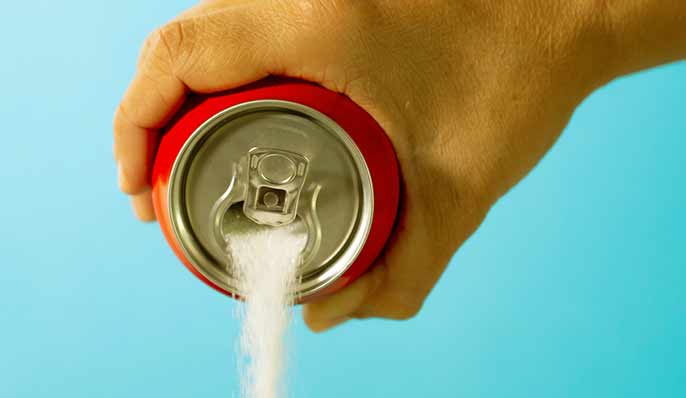
North Carolina State University has just published an article addressing the questions regarding sucralose, one of the most commonly used artificial sweeteners in «sugar-free» beverages and light products. This is not a new study showing that sucralose damages our DNA, but rather a synthesis of previous work, supplemented by more recent scientific data.
The study that triggered the concerns
At the origin of the concern is a study published in 2023 by a team from this university. The researchers focused on sucralose-6-acetate, a substance chemically similar to sucralose that may be present as an impurity in certain products.
In experiments conducted on human cells in the laboratory, this compound showed genotoxic, with signs of DNA breaks. The researchers also observed, in a model of intestinal tissue, an increase in the permeability of the intestinal barrier (the famous leaky gut) as well as activation of genes related to oxidative stress and at the’inflammation.
An older study, dating back to 2018 and conducted in rats, also suggested that sucralose could be transformed in the body into different compounds. However, this interpretation has since been questioned: some molecules found in animals could actually be impurities already present in the administered product.
Other more nuanced studies
Since then, several elements have come to nuance these initial concerns.
In February 2026, the’European Food Safety Authority (EFSA) has reassessed all available data. It has maintained the acceptable daily intake of sucralose at 15 mg/kg of body weight per day, and concluded that its current use as a food additive does not raise any particular genotoxicity concerns.
Another study published in August 2026 on commercial sucralose did not find an overall signal in favor of a mutagenic or genotoxic effect, although some tests yielded results that were difficult to interpret.
It should be noted, however, that several authors of this study had ties to the industry, , and that sweeteners represent a huge market. These are factors to consider in the analysis of the results., Other research suggests that sucralose could have.
biological effects . A human study published in 2025 showed a transient change in hypothalamic activity, a brain region involved in hunger. A review of 23 clinical trials published in 2026 also found contradictory results regarding blood sugar and metabolism.. What should we take away in practice?
To date, it is therefore not formally demonstrated that the regular consumption of sucralose damages DNA in humans. This does not mean that it is metabolically or intestinally neutral.
Furthermore, the most moderate studies do not necessarily present an impartial character.
For a diet favorable to health and longevity, the best strategy is probably to.
gradually reduce our need for sweet taste , rather than systematically replacing sugar with sweeteners. We can possibly consider this need as a sort of addiction, but it is always possible to overcome it., Rouyer.
Two sachets with morning cocoa.
Deux sachets avec le cacao du matin
Two sachets with the midday coffee
Two sachets with the evening petits Suisses.
In principle, I do not exceed this daily dose, except when I have rice pudding for dessert.
My sugar level at the time was 2.23; today it is regularly at 0.90.
I rarely consume more than that.
But then, what about Stevia, Aspartame, and other synthetic sweeteners?
Let us remember that sucralose comes from a plant found in South America.
..