

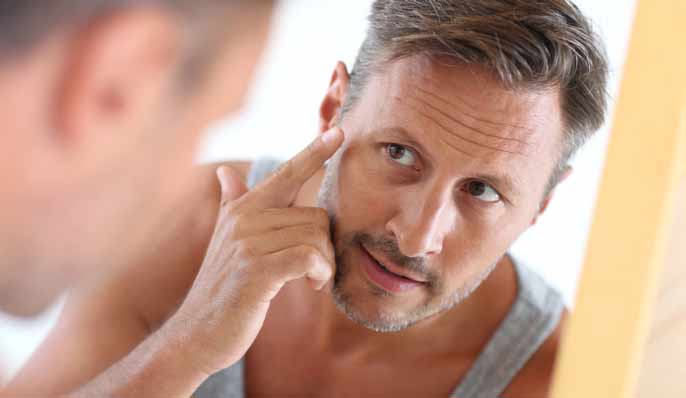
Some people appear 10 years younger than their age, while others, on the contrary, seem to age too quickly. What if your face actually reflected the overall and internal aging of your body?
More and more scientific studies suggest that the appearance of the face could be a true marker of thebiological age. , that is to say independently of our “official” age.
Why is the face so revealing?
Facial aging is not just about the skin. It reflects deeper biological phenomena:
- decreased collagen,
- oxidative stress,
- chronic inflammation,
- muscle loss,
- glycation,
- hormonal declines,
- vascular aging…
However, these mechanisms also affect the brain, arteries, bones, or muscles. Thus, several studies show that a face that appears older is often associated with accelerated overall aging, even with a higher risk of chronic diseases.
Researchers particularly observe that certain signs are strongly correlated with biological age:
- skin laxity,
- loss of facial volume,
- deep wrinkles,
- dull complexion and spots,
- muscle loss,
- alteration of skin quality…
Can AI estimate your biological age?
Research teams are now developing artificial intelligences capable of assessing biological age from a simple photo of the face. Some analyses also take into account the retina, the tongue, or various biological biomarkers.
In individuals with a poor lifestyle — tobacco, sedentary behavior, lack of sleep, chronic stress — the estimated biological age is generally higher than the actual age. Conversely, a good lifestyle seems to slow down this visible aging.
Good news: biological age is not fixed
Unlike chronological age, biological age is constantly evolving. Our lifestyle directly influences the rate of aging of our tissues.
The main factors that can accelerate visible aging are now well known:
- excess sun and oxidation,
- tobacco,
- ultra-processed food,
- chronic stress,
- lack of sleep,
- chronic inflammation,
- pollution,
- sedentary lifestyle…
Conversely, certain strategies seem to slow biological aging such as:
regular physical activity, quality sleep, a diet rich in antioxidants, maintaining muscle mass, stress management, and sun protection.
Today, anti-aging medicine no longer seeks only to "erase wrinkles" but to slow down biological aging itself in a holistic approach… of which the face remains one of the best mirrors.
To calculate your biological age, see our free questionnaire >>>
One cannot appear younger than their age!
On the other hand, one can appear older and that is a problem.
Our lifestyle directly influences the speed of aging of our tissues but not only that, it also opens the door to degenerative diseases. And that is more serious.
Marc
I believe that it is not just the face. The body is equally important to assess biological age. Too much fat or not enough muscle is significant.
I completely agree with you. Just like physical abilities and the capacity to perform certain exercises or tests are very telling.