

In terms of physical activity and longevity, many think of several hours of sports per week, regular gym sessions, or even complex programs that are difficult to follow in the long term. A study published in March 2026 in the scientific journal PLOS One challenges this common belief.
4 minutes of daily exercise, it works
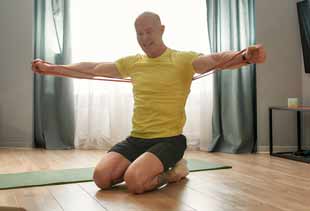 Researchers from the Penn State College of Medicine evaluated the effect of an extremely simple program in adults over 65 years old who already had mobility difficulties. The protocol, named FAST-2 (Functional Activity Strength Training), only required 4 minutes per day of muscle strengthening exercises.
The program was based on four functional movements: getting up from a chair, performing adapted push-ups, doing band pulls, and stepping onto a step. In this study, each exercise was performed for 30 seconds, followed by 30 seconds of recovery. In total, this represents only 4 minutes daily.
After 12 weeks, the results surprised the researchers. Participants significantly improved their lower limb strength, balance, and ability to get up from a chair. They averaged:
- 4.2 additional repetitions on the chair rise test in 30 seconds,
- a balance hold on one leg for 3.6 seconds longer
- 2.3 seconds less on average in their time for the sit-to-stand test.
These figures may seem modest but they correspond to nonetheless significant improvements in daily life. For seniors, the ability to easily get up from an armchair, climb stairs, or maintain balance is directly associated with a reduced risk of falling, better autonomy, and a longer life expectancy.
It is regularity that pays off
The other major lesson from this study concerns adherence. Participants completed their program on 81% of the scheduled days, a remarkable rate compared to traditional exercise programs that are often abandoned after a few weeks.
This study reminds us of a fundamental principle of anti-aging medicine: regularity is often more important than intensity. It is better to practice a few minutes of exercise each day than to plan long sessions that one ends up never doing.
So, if you lack time or motivation, start "small."
A few minutes of daily movements engaging the legs, arms, and balance can already help preserve muscle mass, support mitochondria and their energy production, maintain autonomy, and promote healthier aging.
As in intense intermittent exercise, which works well to preserve muscle mass, it is not always the duration of the exercise that matters.
After all, let's not kid ourselves: this does not mean that 4 minutes of exercise is enough to optimize longevity. It is clear that the results can be better with longer durations.
However, this teaches us that consistency and repetition of care are important. And that even very little exercise is better than nothing.
The study: Dandekar S. et al. Functional Activity Strength Training (FAST-2): A randomized trial of four minutes of daily resistance training in older adults with mobility limitations. PLOS One, 2026.
Man, 74 years old, last year I did exactly 01H43 minutes of sports per day (walking, stationary bike, push-ups, swimming/crawl, weights, gymnastics, and a lot of elastic). Let's use this retirement wisely to "rejuvenate" in good conditions. As a result, in great shape and a "cascade" of compliments on my physical condition which, let's be honest, flatters my ego. Good sleep, dietary food, no tobacco, no medications, no stress.........and a little alcohol.
I note what I do in a notebook.
Best regards
Thailand
I completely agree with you. The foundation is there, and we can go a little further with the methods explained on this site.
Continue for a long time.