


The hunched posture with the head forward often develops with age and is a very visible sign of aging. It also brings its share of health issues. So what can we do?
When the silhouette looks old
Posture, silhouette, and appearance are probably the first elements considered when assessing a person's age.
Even a beautiful smooth face will not enhance its owner if it is associated with a body lacking lumbar curvature, flat buttocks, and a hunched back. This is all the more cruel because this evolution, which we will discuss further, is inevitable in the absence of a counter-offensive. Moreover, no aesthetic technique can truly reinflate the intervertebral discs, round muscles (buttocks, shoulders...), or straighten a sagging spine.
- When the silhouette looks old
- Exercise has effects on health... and on posture
- Evolution of posture in aging
- The consequences of this posture on health
- How to fight against the skier's posture
- Muscles to strengthen as a priority
- How to go about it?
- Strengthening exercises
- The big secret: enjoyable exercise!
Exercise has effects on health... and on posture
The only response can only be endogenous without possible exogenous contributions. Furthermore, good posture is synonymous with good health. The recommendations regarding this posture align with those that protect us from orthopedic deterioration initially, and physiological deterioration subsequently.
A remarkable study was conducted in the United States. It is based on the gigantic panel of results collected since 1993 during consultations following the diagnosis of four types of cancer: prostate, lung, ovarian, and colorectal. Each time, the question of physical activity was asked.
Approximately 100,000 files have demonstrated and confirmed several things. First, and as expected, exercise reduces mortality. What dose? The classic figure given by the American Guideline is between 2 hours and 30 minutes and 5 hours per week.
With which sports?
- brisk and long walking, of the aerobic type, reduces mortality by 32%,
- 2 strength training sessions per week are less effective, with -22%.
- the maximum being to combine both: -47% mortality.
Based on these figures, the authors sought to understand why. One of the hypotheses is quite simple and seems to be the most accepted. By toning all the muscles we achieve postural stability. Hence a better stride length, increased vital respiratory capacity, and a decrease in the number of falls (a major issue in the 4th age). (1)
As we can see, good posture allows us to age without becoming old, while maintaining a «nice appearance» and also living longer.
In the same spirit, a well-conducted study showed that the natural walking speed is a very reliable indicator of the stage of aging. At least as much, if not more, than all the most advanced blood tests.
Let’s take this opportunity to remind that one of the key measures in the fight against aging is therefore to walk fast. Think about it in all circumstances. A hike? With or without poles (better without, by the way) and you try to walk fast, on the verge of breathlessness.
You took up golf to have fun but also to walk. If you walk slowly, there’s no effect to expect on your figure. It is said that good players walk fast and play slowly, while for the poor player, it’s the opposite.
Evolution of posture in aging
But let’s return to posture. Ready for a good dose of gloom?
Aging makes us lose our muscles. This is the famous sarcopenia, which is one of the most deleterious effects of aging. Why? We thought we knew by invoking the decline of hormones and all physiological functions, but recent research has highlighted the role of mitochondria and free radicals. A very complex mechanism but which explains how important it is to start physical activity as early as possible (2).
All muscles are affected, but the primary target consists of the round muscles : the glutes, the deltoids, the pectorals to name just a few.
At the same time, the stabilizing muscles of the spine are the site of lipid infiltration, an infiltration of fat layers that eventually take up all the space of the back muscles. When we perform MRIs of the spine for lower back pain, we see these «white muscles» which are said to be «poliomyelitic» because they can no longer return to their previous state. «We do not muscle fat.».
 The result of this degradation, particularly concerning the lumbar curvature, is that the spine is no longer held. The vertebrae sometimes slide forward, a scoliosis known as «de novo» or simply a loss of curvature. It's not attractive on flat buttocks but it also has multiple repercussions.
The spine becomes less flexible and the discs collapse (*), To maintain a horizontal gaze, the curves of the spine change. The subject hunches and excessively arches their neck which ultimately becomes painful.
To perfect the whole, good balance is achieved through a slight bending of the arms and lower limbs. The EOS exams (radiographs of the entire skeleton from the front and side, almost without X-ray radiation) show this dramatically.
We then speak of « the skier's posture » :
- loss of lumbar curvature,
- thoracic kyphosis,
- shoulders forward,
- bending of the arms and knees.
Finally, this dorsal hump and this absence of curvature automatically cause fat deposits on the belly.
The consequences of this posture on health
The entire dynamics of the subject will be disrupted. Shortening of the stride, loss of flexibility, and thus, the overall performance decreases.
The cascading effect then occurs with a decrease in cardio-respiratory capacities which leads, in the short or long term, to possible aging pathologies (atherosclerosis, pulmonary sensitivity to infections, etc.).
Poor posture can affect the exercises by compressing the lungs and limiting respiratory volumes.
Moreover, this change in posture generates modified supports at the joint and spinal levels, accelerating degenerative phenomena: coxarthrosis, gonarthrosis, narrow spinal canal… and some pain musculoskeletal, particularly in the neck, back, shoulders, and knees.
Kyphosis (hunched back), when it worsens, can lead to stomach compression and gastroesophageal reflux in very advanced cases (especially in old age).
Depression and anxiety: an incorrect posture can also affect mood and cause symptoms of depression and anxiety.
How to fight against the skier's posture
That's enough, thinks the novice skier. It's time to take action. What do we inevitably do? We start by strengthening our abs, of course. One must lose their belly, or so we think.
Don't make this mistake!
Let's first remember that doing abs does nothing to change fat deposits. Moreover, a belly is not lost in a traditional gym. It's actually the opposite.
Meyer, an American doctor, has shown that abdominal exercises are harmful for back pain and posture. In good health, the strength of the back muscles (extensors) is at least equal to that of the abs. In subjects with loss of lumbar lordosis (curvature), this work on the abs disrupts that balance and increases flexion, inducing compression of the abdomen.
Muscles to strengthen as a priority
Furthermore, the abs have a cross shape. The large portion (the six-pack) has no utility for posture while the horizontal branch (the transverse muscle) is a true belt.
This transverse is not worked by lifting the legs while lying on the back. The cat exercise (see below) is the most well-known for developing this transverse.
It is indeed the muscles that straighten the trunk (called erectors or extensors) that need to be developed. They have names that are hard to remember: multifidus, quadratus lumborum, psoas.

At this point in the article, we need to provide practical information or risk frustrating the reader.
So let's summarize:
- the loss of lumbar curvature is the tenth plague of Egypt. Everything must be done to preserve it.
- muscle wasting is inevitable but can be halted by sustained physical activity.
- regaining or maintaining curvature is the result of long and patient work, practically equal to learning a new language. And everyone knows that it's easier to learn English at 18 than at 60. So, the earlier you start, the better.
How to go about it?
One cannot be exhaustive nor have a miracle recipe. Each individual has their own dynamics and their own libido (in the general sense), and will find pleasure in various physical activities.
It is out of the question to be in a forced and martyring sport. That is the passport to failure.
Strengthening exercises
For those who wish, certain exercises, performed regularly, will strengthen the muscles we have discussed. Here are a few examples:
Isometric exercises
We only hold the position for a certain amount of time. Doing it on a ball increases the difficulty and thus the muscle work. These exercises engage different muscle groups that are particularly important for improving posture.

The cat exercise:
On all fours, arch your back as much as possible while inhaling and lowering your belly, then exhale forcefully while rounding your back, feeling as if your navel is going to touch your spine. It effectively strengthens the transverse muscle.

Other dynamic exercises
For the most motivated individuals, capable of practicing them regularly, here are 4 other useful exercises against the hunched position of skiers:


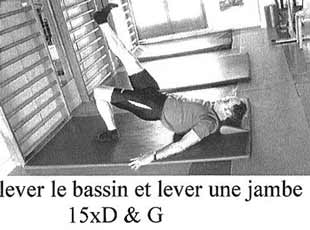
Thus, the top priority is to strengthen the muscles, but intelligently: particularly through sports or exercises that facilitate the extension of the entire body, through self-erection work of the trunk in front of a mirror. We aim to grow taller as much as possible.
Stretching
Models learn to walk by balancing a heavy book on their head while walking. Try this little experiment: while standing, tuck your chin in by 1 cm. Not up or down, but horizontally. Immediately, you feel all the muscles in your spine working, particularly in the lumbar area.
Any work of stretching with the aim of maintaining good joint range of motion is also important.
Let us remember that these exercises are not recreational. They should be done in sets and reach 40-60 repetitions. It is only when it «burns» that the mitochondrial machinery kicks in. For each exercise, you need to push to the limit of muscle exhaustion. So, know how to return to it during the same session. The muscle will first «wake up,» then «hypertrophy,» and then multiply its fibers (after a few years...).
The big secret: enjoyable exercise!
A very old experiment was conducted in the 1980s: a rat was placed in a cage with all possible comforts, toys, a good temperature, food and water ad libitum, and a soothing sound environment. With a stick, the researchers gently encouraged the rat to run in a wheel several times a day. This rat lived well, was pampered, and exercised.
After a month, it was sacrificed and its brain was examined. In particular, the hippocampus, which is, broadly speaking, the center of intelligence and memory. This was found to be atrophied by about 20 to 30%, indicating that this rat had suffered, was stressed, and had therefore lost cognitive abilities and experienced mood disorders.

The same experiment was repeated: the same cage but larger, the same pampering, the same exercise in the endless wheel. The only difference was that several rats were placed in the cage. They cohabited peacefully. They were sacrificed, and to our surprise, we found hippocampi that had increased in volume by 30%! No stress, no martyrdom thanks to social interactions and shared exercise.
So, to regain your arch, find pleasure if one dares to say, among friends, in competition, in a group, etc. Make sure it is a moment that stimulates the reward center. If it’s with a coach, ask to alternate or combine aerobic exercise (get out of breath!) and strength training focused on the aforementioned muscles during the week. But if you miss a session because you have to go hiking in the mountains or skiing with family or a snowshoe outing, that’s just happiness.
 If you go running all alone, have a watch to show the distance and speed. Set yourself challenges by trying to beat your records and thus reward yourself.
Even for exercises in the gym, increase the number of exercises and their execution speed or the time you can hold during isometric exercises. Do not focus on the result in front of the mirror but rather on your progress displayed on your watch, or on the fact that you finally beat your sports partner.
Everything will straighten up : the head, the arch, the shoulder placement, your self-esteem, and you will enter a virtuous circle. We can then refine the management and guide you more precisely with the help of a professional.
So, meet again in a few months even though I imagine you will have found your own dynamic… and your beautiful arch.
(*) disc degeneration is caused 30-40% by too heavy efforts but also by a chronic lack of stabilizing musculature. But life is unfair, discs also collapse because they are poorly programmed genetically, and in this matter, one must choose their parents well…
Ref:
- Joint and independent association of weightlifting and aerobic activity with mortality in the prostate, lung, colorectal and ovarian cancer screening trial in British Journal of Sports Medicine, Sept 2022
- Molecular Regulation of Skeletal Muscle Growth and Organelle Biosynthesis: Practical Recommendations for Exercise Training, in International Journal of Molecular Sciences, March 2021

Hello doctor,
article and very interesting comments, thank you.
What do you think of Nordic walking?
Sincerely,
ElizabethM.
where to find a club that practices this in Annemasse 74100
In principle, all gym clubs should be able to offer this. The key is to find a trainer who can guide you with the right exercises and provide proper corrections.
Little informed, generalist incapable, in short, during a hospitalization at 70
years old, for 4 weeks, I lost my gluteal muscle strength, and my athletic life had kept me well, but after the operation, I gradually abandoned yoga, cycling, walking, and now I am struggling with lumbar scoliosis and all exercises are difficult, physiotherapy and osteopathy, and I maintain daily walks. I will try to do your exercises with the osteopath.
Hello doctor, thank you for this information, I instinctively practice several of these exercises, seeing them recommended is quite encouraging. I stopped at 30, not daring to reach the stage of burning sensation, so this clears up the doubt.
just one question, is the pelvic lift position compatible with cervical osteoarthritis with slight loss of curvature? (I haven't worried about it to be honest as I am so pleased with the results of this exercise, which is also very relaxing)
Yes, it is compatible... provided it is not painful during and after.
Put a small soft cushion under your neck. Good luck!
Dr. CD
Thank you, doctor. Your article is pleasant to read and very lively. But could you please provide a few more exercises that are good for the skier's posture for those who are ready to push themselves? ;-)
Thank you for your appreciation.
I just added some photos to the article, which are better than long explanations for 4 exercises that are among the best in my opinion, and for those who want to practice them regularly.
Very interesting and informative article…
Interesting article