

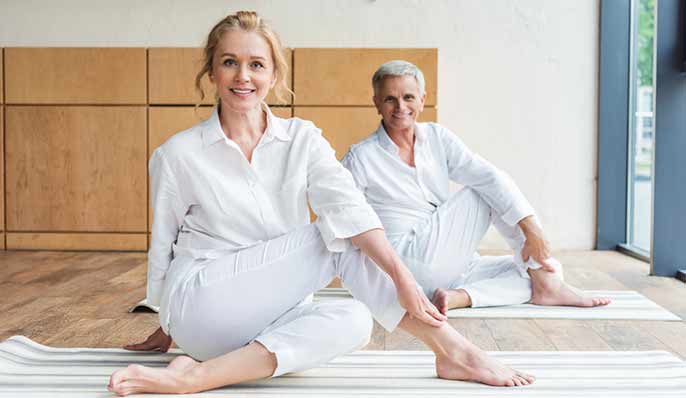
Studies show that yoga is an ally against biological aging, but can it also increase the life expectancy of its practitioners? Can it have a real effect on aging markers?
A 102 years, Charlotte Chopin is living proof of this. Three times a week, this yoga teacher with the flexibility of a reed conducts her classes for diligent and admiring students. Like Daisy Taylor, another British centenarian of 105 years, she is convinced that her physical and mental health relies on yoga, combined with her optimism and an ability to appreciate the little things in life.
Numerous studies (1) support the positive effects of yoga on health, especially as we age. The benefits include a reduction in high blood pressure, blood lipid levels, and obesity, as well as a decrease in stress, anxiety, and depression.
Beyond scientific studies, iconic figures in yoga illustrate these benefits. B.K.S Iyengar, a great master of modern yoga, lived to be 95 years old, despite having very fragile health in his youth. His mentor, Tirumalai Krishnamacharya, reached the age of 100, and Krishna Pattabhi Jois, a pioneer of Ashtanga, lived to be 93.
An ally against aging according to science
Yoga lengthens telomeres
Recent research suggests that yoga may act at the cellular level by slowing down aging. One study showed a 43% increase in the activity of the telomerase in yoga practitioners. This enzyme, highly valued and stimulated by certain anti-aging remedies, delays cellular aging by preventing the telomeres from shortening too quickly (see this article on telomerase). The practice of yoga is much more economical.
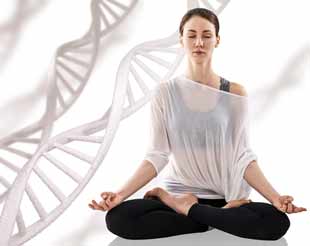
Yoga protects the brain from degeneration
Yoga also protects mental health as it preserves brain mass, particularly in the hippocampus, a key region for the memory. Yogis aged 40-50 often show brain structures equivalent to those of people 20 years younger. Meditation, an essential component of yoga, contributes to this protective effect.
Yoga improves frailty markers related to mortality
A systematic review of 33 studies (in Annals of Internal Medicine 2023) involving 2,384 people over 65 years old, shows that yoga increases the walking speed and lower limb strength, two key indicators of longevity. Slow walking speed is associated with an increased risk of mortality (2).
This improvement significant in physical abilities related to autonomy and survival tells us that many seniors (and certainly others) could live longer and better by regularly practicing yoga.
It is never too late to start yoga and improve your aging markers.
More flexibility = longer life
A Scandinavian study from 2024 demonstrated that physical flexibility often developed through yoga, is associated with lower mortality, over a follow-up period of nearly 13 years in individuals aged 46 to 65 years (3).
Furthermore, some experienced practitioners manage to reduce their metabolism similarly to hibernating animals, a strategy linked to greater longevity.
All these scientific studies clearly show that yoga not only improves fitness but also longevity.
Epigenetics and yoga
Epigenetics is a fascinating field that studies how our behaviors and environment can modify the expression of our genes without changing the DNA sequence itself. Certain factors such as diet, stress, or physical activity can «turn on» or «turn off» certain genes. And these epigenetic modifications can be passed down from generation to generation, making it a crucial area of study to understand how our daily actions influence our genetic legacy. This phenomenon thus has direct implications for our health, well-being, and even our aging.
A growing stream of scientific research focuses on the positive influence of yoga on gene expression.
A study (4) conducted by researchers from Coventry University and Radboud University demonstrated that gentle body practices such as yoga (asanas, pranayama, and breath work), meditation, and Tai Chi can reduce the production of pro-inflammatory cytokines, which directly affect gene expression related to inflammation and stress. The results speak for themselves: practicing yoga regularly can lead to quantifiable changes in messenger RNA, thereby reducing the risk of inflammatory diseases.. Other studies even show an improvement in epigenetic markers related to psychological resilience.
A holistic practice to stay healthy
Ayurveda, which literally means science of life, is the ancestral medicine originating from India. It defines health as a perfect harmony of bodily functions, a well-balanced metabolism, and a happy and balanced state of mind and senses. Ayurveda combines daily yoga sessions with regular oil massages, a healthy diet, and the practice of meditation to maintain health.
If aging is considered a slowing down of energy circulation, sometimes accompanied by the onset of diseases, which like any «mal-a-dit» is a disturbance of the normal functioning of the body and mind, yoga can indeed help delay the markers of aging.
In her book «Yoga, a Jewel for Women,» Gita S. Iyengar explains that «asanas are psychophysiological while physical exercises are purely external» (5). Like gymnastics exercises, asanas strengthen deeply and stretch gently, making movements increasingly easier. «The whole difference with physical gymnastics exercises is that asanas also address the physiological body and vital organs.»
The regular practice of asanas strengthens and revitalizes the organs and more broadly the digestive system, the respiratory system, the hormonal system, and the nervous system.
In practical terms, it is not necessary to have an advanced practice to feel the benefits of yoga. The most important thing is to practice with regularity, for a beginner, once a week is a good start. Yoga is for everyone and can be started at any age. You just need to be motivated enough to walk through the door of a yoga studio to begin practicing. And especially not to get discouraged if you don't connect with the teacher or their way of teaching. Sometimes you need to try several classes and several centers before finding the method that suits you.
I recommend practicing under the guidance of a teacher, with a personal practice being able to develop later at home once the basics have been understood and acquired.
Yoga is not only preventive but also curative. Gita Iyengar, for example, had a difficult childhood, suffering from chronic fever, headaches, contracting typhoid fever, jaundice, diphtheria, and even nephritis from which she miraculously recovered after being unconscious for several days in the hospital. Back home with a long list of medications to take every day, her father B.K.S. Iyengar insisted that she start practicing yoga asanas. Little by little, her condition improved to the surprise of the doctors, and she became a beloved yoga teacher like her father, who is actually the originator of yoga therapy, which has become so fashionable in recent years.
Which postures to practice? All!
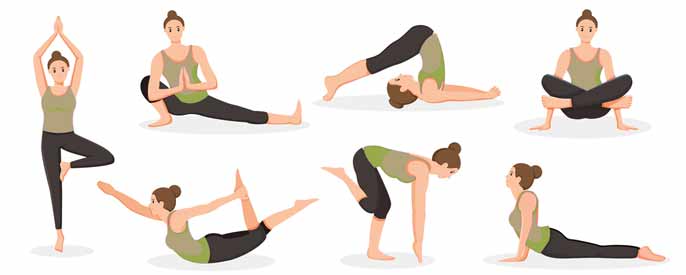
Hatha yoga is traditionally composed of families of postures:
- standing postures,
- forward bends,
- seated asanas,
- back stretches,
- twists,
- abdominal strengthening postures,
- inverted postures,
- and pranayama, the art of breath and respiration.
A complete class offers postures from each of these families in a specific order. First, standing postures that strengthen the legs and teach grounding and balance, then seated postures often combined with forward bends and twists, followed by backbends, and finally inverted postures to conclude with lying down asanas for deep relaxation that play a key role in the practice of yoga.
The most well-known is Savasana, the recovery and relaxation posture that ends each session. This posture calms the nervous system, releases physical and mental tensions, and improves sleep quality. It is an essential moment to fully integrate the benefits of the practice while providing a feeling of total serenity.
Despite the lack of studies, experience shows that integrating holistic natural methods such as yoga and meditation into our daily lives can have beneficial impacts on our health. We all have one or more practitioners in our circle who prove this to us through their vitality and positivity. Current scientific advancements encourage us to adopt such practices to improve our quality of life and overall well-being.
(written in collaboration with Dr. JL Morel)
Cécile Lucot has been a hatha yoga and meditation teacher for over 15 years. She teaches at her studio Le Cocon BA in Arcachon. Her classes express the holistic dimension of yoga through which the body and mind subtly unite.
Her next spiritual retreat will take place in Egypt from November 10 to 20, 2025. There are a few spots left. For more information: www.shanti-yoga-arcachon.com



Hello doctor,
First of all, thank you for your monthly Anti Age letter. Great!
This information is of great interest to me. Indeed, I have been interested for over twenty years now in how our body functions, particularly the fascia.
I have derived a very pleasant quality of life as well as good health from it. I am 81 years old, and many people are surprised by my younger physical appearance.
I believe I owe this to a daily stretching routine accompanied by self-massages of the fascia, as well as good nutritional hygiene. I also practice yoga, Pilates, hiking/cycling, and I dance rock and roll. Pure happiness!
Furthermore, deepening my knowledge and research has led me to certain intuitions, such as the effectiveness of fascia massage and stretching. I believe that stimulating interstitial fluid positively affects the ‘fascial and myofascial’ tissues due to its ability to transmit restorative flows.
With all my encouragement!
Marc
Thank you, Marc, for your compliments. Yes, improving lymphatic and blood circulation in general is very important for health as we age, and thus for longevity. Everything that moves and stretches is therefore welcome. Thank you for sharing your experience. Take care and live long.